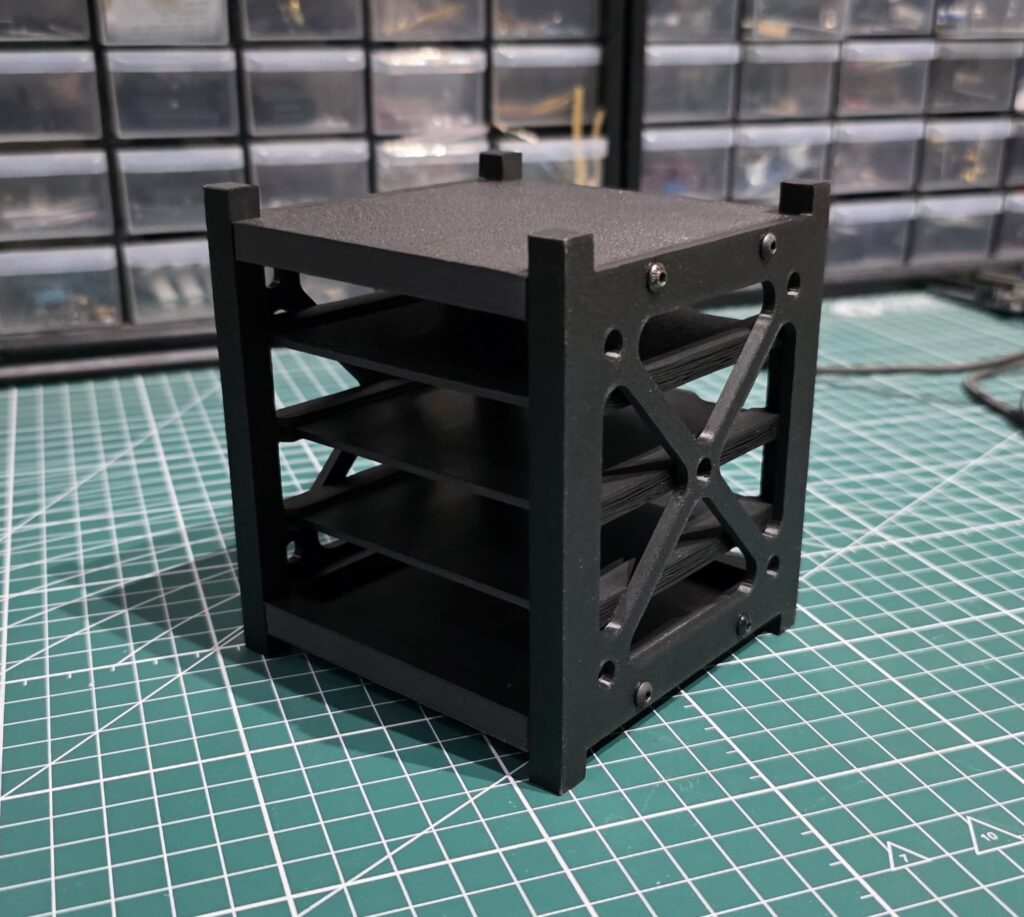
CubeSat is a class of miniaturized satellites designed using a modular standard, typically measuring 10×10×10 cm (known as 1U). Originally developed in the early 2000s as an academic initiative, CubeSats have since become a cornerstone of space education, research, and low-cost technology demonstration. Their compact size, low manufacturing cost, and reliance on commercial off-the-shelf (COTS) components have democratized access to space, enabling universities, research centers, and startups to carry out real orbital missions in areas such as Earth observation, space-based experiments, and communication systems testing—all within limited budgets and short development timelines.
Why This Project?
Given my interest and academic focus in embedded systems and space technologies, I chose to work on a CubeSat prototype to explore the inner workings of satellite subsystems and gain practical experience in aerospace engineering. Due to the limited availability of launch or testing facilities, I aimed to develop a CubeSat simulator—a hardware-based educational platform that replicates core satellite functions on the ground.
This project began by studying and understanding the essential subsystems of CubeSats, such as sensors, communications, data processing, and power management. I then moved toward building a functional prototype that serves as a learning tool, particularly for students or researchers in early stages of satellite development.
Additionally, I sought to go beyond simulation by exploring future applications such as plant growth experiments and bacterial behavior analysis in space environments, aligning this work with the growing interest in bio-research on CubeSat platforms.
Project Goals and Objectives
-
Build a functional CubeSat prototype integrating sensors and telemetry.
-
Enable real-time environmental monitoring (temperature, pressure, light, motion).
-
Establish a wireless communication link using LoRa.
-
Create a responsive web dashboard for live sensor visualization.
-
Provide a testbed for future educational and biological research applications.
System Overview
The prototype consists of:
-
On-Board Computer: Raspberry Pi 4
-
Sensors: MPU-9250 (IMU), BMP280 (pressure & temperature), LTR390 (UV & light)
-
Communication: LoRa E32 module + ESP32 ground station
-
Power: Battery-powered system with simulated solar support
-
Software: Flask-based live dashboard, with downloadable CSV and live video feed
-
Output: Real-time data monitoring, CSV export, visual alerts for temperature/light anomalies
Key Achievements
-
Sensor Accuracy: Most sensors performed well; magnetometer accuracy needs enhancement.
-
Telemetry Range: Up to 850 meters in field tests; acceptable performance indoors and in urban areas.
-
Interface: A fully functional web-based monitoring system was developed for real-time analysis.
Educational Value
This project provides a practical, interdisciplinary platform to learn about:
It prepares students to work on real CubeSat missions and contributes toward national and regional efforts in small satellite development.
Future Scope
-
Add Attitude Determination and Control System (ADCS) for orientation control.
-
Simulate orbital missions and environmental exposure.
-
Explore biological payloads such as microplant growth and microbial studies.
-
Improve system resilience for eventual deployment.